What is Energy Recovery in Compressor Installations?
Many installations that produce compressed air offer significant and frequently underutilized energy
saving possibilities
in the form of waste energy recovery. In large industries, energy costs can amount to 80% of the total cost of compressed
air production.
However, a lot of this energy can be recovered, which in turn will save you a lot of money.
What is waste energy recovery in compressor installations?
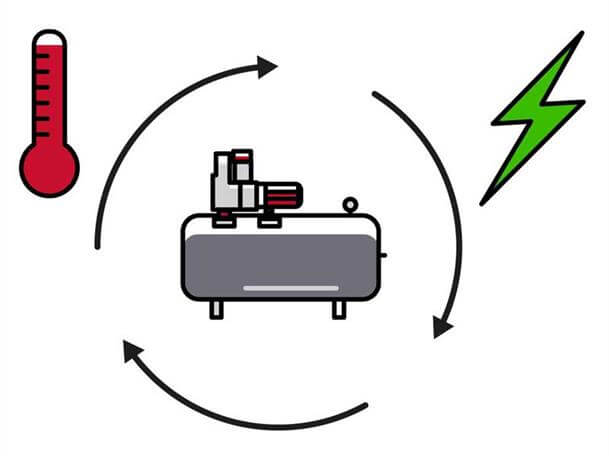
When air is compressed heat is formed.
Before the compressed air is distributed into the pipe system the heat energy is extracted, and becomes waste heat. For each compressed air
installation, the issue of sufficient and reliable cooling capacity for the installation must be addressed. Cooling can take place
either by means of the outdoor air or a cooling water system that uses municipal water, stream water or process water in an open or
closed system.
A compressor central plant in a large industry that consumes 500 kW over 8,000 operating hours per year represents a yearly energy
consumption of 4 million kWh. The possibilities for recovering substantial amounts of waste heat via hot air or hot water are real. As
much as 94% of the energy supplied to the compressor can be recovered, for example, as 90°C hot water from oil-free screw compressors.
This fact illustrates that saving measures quickly provide substantial return.
The return on investment for energy recovery is usually as short as 1–3 years. In addition, energy recovered by means of a closed cooling
system enhances compressor operating conditions, reliability and service life due to an equalized temperature level and high cooling
water quality, to name but a few advantages. Nordic countries are somewhat of a forerunner in this arena and energy recovery has been
standard practice for quite some time now for compressor installations. Most medium to large compressors from the major suppliers are
now adapted for fitting with standard equipment for waste heat recovery.
How do we calculate the recovery potential?
The laws of physics dictate that nearly all energy supplied to a compressor installation is converted into heat. The more energy that can be
recovered and utilized in other processes, the higher the system's overall efficiency.
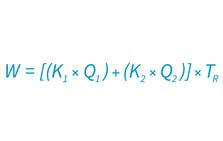
Recovered energy in kWh/year:
Savings per year: (€)
TR = Time of recovered energy demand (hrs/year)
K1 = Part of TR with loaded compressor (hrs/year)
K2 = Part of TR with off-loaded compressor (hrs/year)
Q1 = Available coolant power with loaded compressor (kW)
Q2 = Available coolant power with off-loaded compressor (kW)
ep = Energy price level (€/kWh)
η = Normal heat source efficiency (%)
In many cases the degree of heat recovery can exceed 90% if the energy gained by cooling the compressor installation can be utilized
efficiently. The function of the cooling system, the distance to the point of consumption, and the degree and continuity of the heat
requirement are all decisive factors. With large thermal flows, selling the recovered heat energy is a possibility that should not be
ignored. The electrical energy supplier could be a potential customer, and investment, sub-order and delivery could readily be
negotiated. An opportunity for savings also exists by coordinating energy recovery from several processes.
How to recover energy in an air-cooled system?
Energy recovery from compressed air installations does not always result in heat when it is required and oftentimes, not in sufficient
quantities. The quantity of recovered energy will vary over time if the compressor has a variable load. In order for recovery to be
feasible, a corresponding relatively stable heat energy demand is needed. Recovered waste heat energy is best utilized to supplement
energy supplied to the system. That way the available energy is always utilized when the compressor is operating. Options for air-cooled
compressors, which produce a high hot air flow rate at a relatively low temperature, are direct building heating or heat exchanging to a
preheating battery. The heated cooling air is then distributed using a fan.
When buildings do not require additional heat, the hot air is evacuated into the atmosphere, either automatically by thermostat control or
manually by controlling the air damper. A limiting factor is the distance between the compressors and the building that needs to be
heated. This distance should be limited (preferably the distance between adjoining buildings). Furthermore, the possibility of recovery
may be limited to the colder periods of the year. Airborne energy recovery is more common for small- and medium-sized compressors.
Recovery of waste heat from compressor air cooling systems results in only small losses from the distribution and requires little
investment.
How to recover energy in a water-cooled system?
The cooling water from a water-cooled compressor with a temperature up to 90° can supplement a hot water heating system. If the hot water is
used instead for washing, cleaning or showering, a normal base load hot water boiler is still required. The energy recovered from the
compressed air system forms a supplementary heat source that reduces the load on the boiler, saves heating fuel and could potentially
result in the use of a smaller boiler.
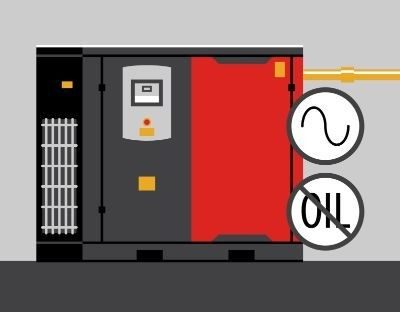
Prerequisites for energy recovery from compressed air compressors differ in part depending on the type of compressor. Standard oil-free
compressors are easy to modify for energy recovery. This type of compressor is ideal for integration in a hot water heating system since
it provides the water temperature (90°C) required for efficient energy recovery. On oil-lubricated compressors, the oil, which takes
part in the compression process, is a factor that limits the possibilities for high cooling water temperatures. In centrifugal
compressors, the temperature levels are generally lower because of the lower pressure ratio per compression stage, thereby limiting the
degree of recovery.
Waterborne waste energy recovery is best suited to compressors with electric motor power over 10 kW. Waterborne recovery of waste energy
requires a more complex installation than airborne waste energy recovery. The basic equipment consists of fluid pumps, heat exchangers
and regulation valves.
Heat can also be distributed to remote buildings using relatively small pipe diameters (40-80 mm) without significant heat losses using
waterborne energy recovery. The high initial water temperature means that waste energy can be used to increase the temperature of the
return water from a hot water boiler. Therefore, the normal heating source can be periodically switched off and be replaced by the
compressor's waste heat recovery system.
Waste heat from compressors in the process industry can also be used to increase the temperature of the process. It is also possible to use
air-cooled oil-lubricated screw compressors to apply water-borne waste energy recovery. This requires a heat exchanger in the oil
circuit, and the system will provide water at lower temperatures (50° - 60°) than with oil-free compressors.
Do you have an idea for our #expertcorner? Let
us know!
Who we are and how Ash Air can help your business!
Ash Air has been around in New Zealand since 1979, and we’ve grown into a nationwide company with international support and a
reputation for quality and reliability.We look after all things compressed air for your business!
Reciprocating, Screw, air compressors
Vacuum pumps
Nitrogen
An extensive line of air treatment components
Ash Air's range of Chicago Pneumatic, Alup, Pneumatech, and Quincy compressors are used extensively around the world in industries
ranging from oil and gas to food, automotive and farming, and we bring you these world class compressors here in the land of the long white
cloud.Our technicians are compressed air equipment experts and are dedicated to addressing customer needs. Supported by a 13 locations
nationwide, Ash Air offers one of the widest selections of compressed air equipment and parts available today in New Zealand.
Reliability and Efficiency
With Ash Air compressors, you can count on reliability and high performance for even the most demanding applications. We focus our
efforts on the following:
Lighting tower reminds night, but also refers to diesel engine. In turn, night reminds us of silence, which is not exactly what we
associate with an engine... With urban centers becoming increasingly dense and legislation increasingly strict about noise pollution in
construction sites, keeping decibels to acceptable levels has been the great challenge of the main construction equipment manufacturers.
Read More…
In today’s world of increasing environmental awareness and the drive for sustainable practices, industries are actively seeking innovative solutions to reduce energy consumption and minimize their carbon footprint. If your business uses air compressors, focusing on energy
recovery in air compressors is one area to pay attention too.
Read More…
Sometimes in the world of compressors the lingo can be confusing. Unless you are totally immersed in the compressor industry, some of the
terminology might be completely lost on you.
Read More…
Did you know that 70% of the total cost of compressor installation consists of energy costs?
There are many reasons why saving energy is important for your business as it helps you in many ways to make your business more efficient as
well as providing you with many different forms of value. Ash Air's range of Alup products can help you become more energy efficient to help
reduce energy bills, reduce your costs and comply with all environmental legislation.
Read More…
Exactly what is compressed air? Where does it come from? What is it for? When we compress—or squeeze—air into a small space, we call it
compressed air. When humans discovered the ability to compress air, civilisation made a huge leap forward. The reason? Compressed air opened
the door to all kinds of new production methods.
Read More…
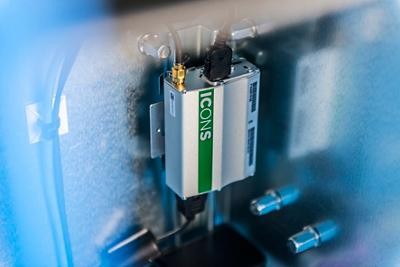
Did you know that conducting an air compressor health check has become even easier? Getting easy and affordable access to your compressor
status information at your fingertips with our Intelligent CONnectivity System (ICONS
Read More…
Compressed air system leaks are indeed a big source of energy waste. Leakage in piping systems have been shown to exhibit leaks of up
to 25
percent of the total energy costs. Addressing
leaks is one of the first maintenance steps a facility can take to reduce energy costs.Read More…
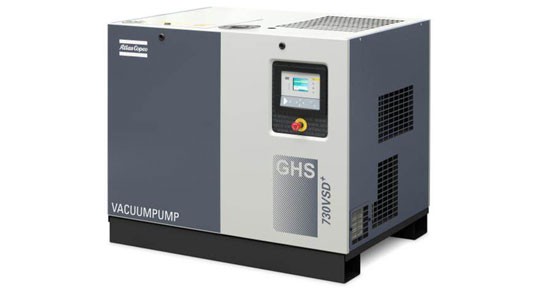
Ash Air is proud to introduce Atlas Copco’s Vacuum Solutions in New Zealand. Here are five things to know about Atlas Copco Vacuum
Solutions!
Read More…
Think about efficiency for a minute. Every year with constant innovation, things are becoming even more efficient. Everything from
electronics to industrial machinery are being developed to get more done faster while using less power.
Read More…
With the Luck of the Irish and a little help from air compressors we will all be enjoying a pint of our favorite beer this St. Patrick’s
Day!
Read More…
The air surrounding us is a mixture of fry air and water vapor. The amount of water in the air depends on the temperature and volume of the
gas. The higher the air temperature, the higher the air's ability to absorb more moisture. Find out about compressed air humidity here.
Read More…
The generator starts up, and not long after, white smoke and oil are seen coming out of the exhaust. It is new, and tested, good
quality diesel... I wonder what happened?
Read More…
Investing in an on-site industrial gas generator is a great way to reduce your environmental footprint and your operating costs. Once you
have taken this important step, there are some other things you can do to maximize your gas generation energy savings. Here are seven of
them.
Read More…
For many businesses, preserving energy and becoming more sustainable have become top priorities. That not only saves them money but also
makes them more competitive in the future, when demand for “green” products and services will only increase. Not just because governments
mandate greater sustainability but also because customers expect it.
Read More…
While you relax and read this, do you see an electronic appliance around you? Wondering how could you relate to the current read?
We got you! Compressed air is all around, in the electronic appliances you use right now.Read More…
There are many contaminants that can threaten your compressed air system, but moisture is among the most prevalent. You may be thinking, but
it’s just water, but water can have a devastating impact on your compressed air system, your production equipment, and your end product. The
best way to prevent moisture from contaminating your compressed air is with a dryer.
Read More…
Compressed air can be one of the most expensive forms of energy for manufacturing plants, often using more energy than other equipment. One
horsepower of compressed air requires eight horsepower of electricity. With many air compressors running at efficiencies as low as 10%,
there’s often plenty of room for improvement. Fortunately, 50% of compressed air systems at small- to medium-sized industrial facilities
have opportunities for low-cost energy conservation.
Read More…
As easy as it would make all of our lives, vacuum pumps are far from being “one size fits all”. Not only do you have the size to consider
when choosing a vacuum pump, but more importantly type. I will briefly touch on some of the advantages and disadvantages associated with
each vacuum technology we deal with. This should give you a better understanding of where to begin your search...
Read More…
A nitrogen generator, combined with an air compressor and the necessary air treatment products, can provide you with a steady supply of food
grade nitrogen.
Read More…
AIRnet offers moisture-eliminating drop fittings called Quick Drops! Quick Drops make “drop-tees” obsolete, removing the need for extra
parts and pipe, while saving time and money.
Read More…
Proper compressor installation and commissioning helps ensure trouble-free startup and long-term reliability. Thorough inspection and
critical review during each phase of the installation process eliminates “built-in” deficiencies or problems which c...
Read More…
Stainless steel has long been crucial for many applications where strength, durability, and resistance to corrosion are
essential. That is why it is often chosen for process equipment used in harsh environments such as chemical and
petrochemical plants, refineries, and power stations.Read More…
Price is an important consideration when choosing a tool for metalworking applications, but it alone should not be the deciding factor.
Other things also contribute to the total cost of ownership, performance, and, ultimately, the overall productivit...
Read More…
Horsepower? PSI? CFM? There is a lot to consider when purchasing a new air compressor. It is important to understand what you actually need
and how to find out.
Read More…
Yay! It's Christmas! But before the turkey gets carved and a heaping spoonful of Christmas pudding gets dropped on your plate, you might get asked what you’re thankful for. Well, maybe this year you could say you’re thankful for the compressed air, gas and vacuum solutions that
made everything on the table possible. Let’s look at how!
Read More…
Are you faced with the decision of whether to switch from purchasing bottled nitrogen or oxygen to on site gas generation? In that case, the
decision is easy. You should! Lower costs, the right purity, less transportation emissions, improved safety, no logistics headaches. In all of these areas, on site gas generation is the superior solution. And making the switch is easy. All you need is a gas generator and a supply
of compressed air.
Read More…
Did you know that one of the largest costs for industrial manufacturers is compressed air? That’s right – anywhere from 12% to 40% of a facility’s total energy costs come from its compressed air installation. This means that finding innovative ways (no matter how small) to
increase compressed air efficiency can amount to big savings over the long run! Items like leak elimination, air audits,
reduced pressure bands, and reducing unloaded running hours are some of the most popular ways to decrease energy usage – but there are many
other actions that you can take. Read on to discover additional ways to reduce your costs and make sure your compressor system is running as
efficiently as possible!
Read More…
A properly sized and designed piping system is a necessary component of any distribution compressed air system. Without this key component
in place, the delivery of air from the compressor to the specific points of use will be inefficient and costly, both in the short term as
well as in the long term. Let’s look more closely at how to size your compressed air piping system to ensure minimal pressure loss while
maintaining maximum efficiency.
Read More…
Potential for growth of micro-organisms in a compressed air system is tied to the moisture level (dew point) of the compressed air. In
simple terms, if there is moisture in your compressed air, microorganisms such as mold and bacteria have the environment they need to grow
and thrive. While it’s true that as air is compressed, much of the moisture present in the intake air will condense, enough moisture remains
to allow micro-organisms to proliferate.
Read More…
Your compressor installation is a workhorse that requires regular service and maintenance to help it achieve maximum efficiency and
longevity. This is where compressor monitoring and data gathering technologies come in, as these provide meaningful information on your
system that can be visualized, tracked over extended time periods, and used to make insightful decisions regarding compressor
performance.
Read More…
Some piston compressors use cast iron and others aluminum. But which is better? Here is a look at their differences and respective benefits.
Read More…
A variable speed compressor is not for every application. VSD rotary screw compressors need to be ran in a location that is in need of 24/7
compressed air and has a changing demand on the amount of air needed. If your compressed air needs are constan...
Read More…
Compressed air purification equipment must have a very low pressure drop, long service life and be strong enough to withstand the most
strenuous operating conditions. Protection from oil slugs or compressor air/oil separator failure is essential.
Read More…
Intelligent Connectivity System (ICONS) is the eyes into your compressed air system. Ditch the logbooks, the regular visits to the
compressor room and dealing with surprises with your compressor. • Most maintenance organizations operate between 10% to 40% efficiency •
Most spend more than 50% of time on emergency work • Reactive maintenance costs 3-5 times more than preventive maintenance.
Read More…
Compressed air is used in many different industries. From refrigerator manufacturers to toy makers, companies around the world depend on
compressed air to produce products. It's so important that many consider it a utility as significant as electricity, water or natural gas.
Read More…
As part of a concerted effort worldwide to reduce energy consumption, CO2 emissions and the impact of industrial operations on the
environment, regulatory authorities in many countries have introduced legislation to encourage the manufacture and use ...
Read More…
Air is always contaminated with solid particles such as dust, sand, soot, salt crystals and water as it leaves the compressor. An effective
compressed air treatment system lowers the dew point of the air and takes out the elements that may harm equipment downstream of the
compressor and dryer
Read More…
The ambient temperature in an air compressor’s environment can greatly affect your air compressor’s performance. All air compressors will
generate some amount of water, but depending on inlet air conditions some can produce large amounts of water.
Read More…
Routine maintenance on your screw compressor or piston compressor is vital to ensuring your unit is performing to its
full potential. There are simple checks and inspections you can do daily, weekly and monthly to keep your compressor running efficiently and
to avoid downtime.
Read More…
Whether you use your air compressor for woodcarving, bottling or manufacturing consumables, compressed air plays a critical role in your
business. It is undeniable that compressed air is a valuable source to your applications.
Read More…
There are many things to consider during the selection process of an air compressor for your business. Most important, determining the
proper size of the compressor to match your operational needs.
Read More…
Dewpoint spikes immediately after desiccant switchover (line C) indicate that the desiccant was not sufficiently cooled before being brought
on-line. Hot desiccant will not adsorb moisture well until it cools down, after which the dewpoint should dro...
Read More…
Don’t be alarmed if you find oil in your air compressor tank. Actually, all rotary screw compressors pass trace amounts of oil in the
compressed air. The question is how much is the normal amount of oil in my compressor tank?
Read More…
The ambient temperature in an air compressor’s environment can greatly affect your air compressors performance. All air compressors
will generate some amount of water, but depending on inlet air conditions some can produce large amounts of water.
Read More…
Once you’ve invested in an air compressor your business or home you may ask yourself, “What happens if my compressor needs service?
Needs a filter change? Oil change?"
Read More…
As you know, compressed air filters protect your machine from dirt, dust, oil and water. These contaminants are extremely common in the
areas you would find a compressed air system and will wear down your machine if not properly filtered out.Read More…










.jpeg)


.jpeg)
.jpeg)
.png)
.png)
.jpeg)


.png)





.jpeg)

.jpeg)