How often do I have to service my compressor?

You understand the importance of servicing and performing maintenance on your car, why wouldn’t you do the same for your air compressor? Servicing your compressor is important to help avoid downtime and having decreased productivity for preventable reasons.

Below are few tips to keep your compressor running in tip-top shape:


• Replace Filters: between 1000 to 2000 hours, this should be the air, oil and panel (if applicable) filters.

• 
Replace your oil: Regardless of usage, oil degrades over time and needs to be replaced. Degraded oil CAN cause catastrophic air end failure, which is a very costly repair, much cheaper to just change the oil at least annually (refer to your manual for the exact time).

• 
Purchasing oil: Purchasing CP oil for your CP machine guarantees your machine is running at it’s best performance and increases the longevity of your air needs.

Other Checklist Items:
- Check condensate drains are functioning properly
- Check drain valves and/or switching valves
- Clean and inspect your machine

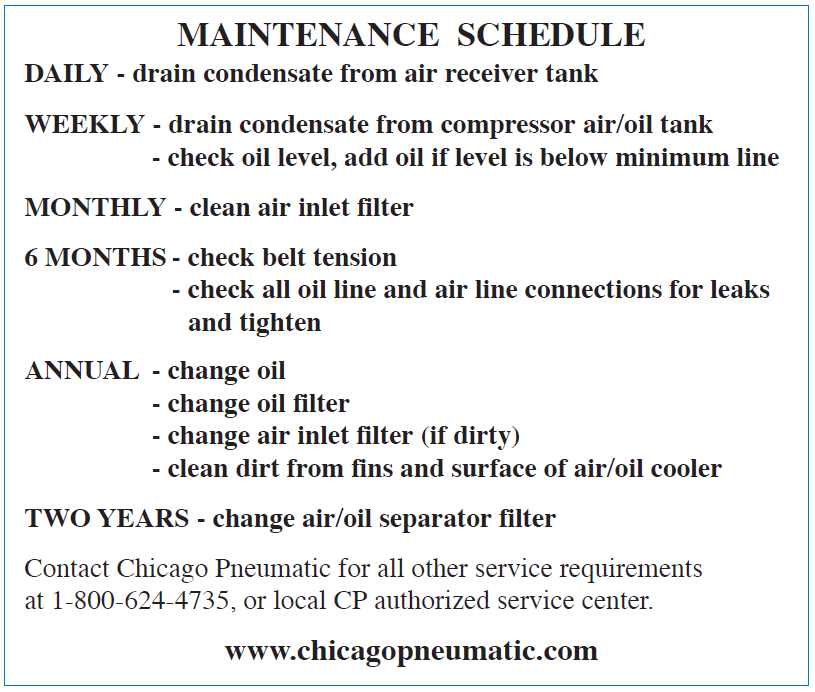
Here's an example of the screw compressor maintenance schedule outlined in the manual

Depending on how often you run your compressor will help you understand how often you need to service your machine. If you’re running your compressor occasionally, then annual service would be adequate. If you are running continuously, then quarterly service may be needed to ensure you are staying ahead of avoidable issues.

Remember, your manual outlines the recommended service and maintenance schedule to keep your air compressor running at optimal efficiency.


Do you have an idea for our #expertcornerLet us know!

Who we are and how Ash Air can help your business!

Ash Air has been around in New Zealand since 1979, and we’ve grown into a nationwide company with international support and a reputation for quality and reliability.We look after all things compressed air for your business!

  • Reciprocating, Screw, air compressors
  • Vacuum pumps
  • Nitrogen
  • An extensive line of air treatment components

Ash Air's range of Chicago Pneumatic, Alup, Pneumatech, and Quincy compressors are used extensively around the world in industries ranging from oil and gas to food, automotive and farming, and we bring you these world class compressors here in the land of the long white cloud.Our technicians are compressed air equipment experts and are dedicated to addressing customer needs. Supported by a 13 locations nationwide, Ash Air offers one of the widest selections of compressed air equipment and parts available today in New Zealand.

Reliability and Efficiency

With Ash Air compressors, you can count on reliability and high performance for even the most demanding applications. We focus our efforts on the following:

  • Increasing uptime
  • Reducing unexpected repairs
  • Reducing energy consumption
  • Improving the cleanliness of compressed air


Talk to the team today:  CONTACT US CONTACT US
Read more from our #expertcorner


There are crucial reasons why you should service and maintain your compressor regularly, with the most common issues being piston failure caused by wear of components, increased friction, corrosion, reduced cooling, overheating bearings and components, clogging of air filters. 


Compressed air is all around us, from the air in a balloon to pumping up tires on your bicycle. In this article we will explain what compressed air is and how it is created. Whether you know it or not, compressed air is involved in every aspect of our lives, from the balloons at your birthday party to the air in the tires of our cars and bicycles. It was probably even used when making the phone, tablet or computer you’re viewing this on. 


One of the biggest challenges is to correctly size your new air compressor. Similarly to everything else, new compressors available on the market are more efficient and employ better technology, therefore you have to understand the application and usage to size the machine correctly. Choosing the wrong air compressor for your facility can lead to problems with production and or increased costs due to wasted energy. 


Once you have the size of the air compressor figured out, the next thing to do is to decide on the type of compresor you will need for your application - piston, rotary screw compressor etc. Let us take a look at two of the most popular options available. When choosing the right type of compressor, you should ask yourself the following questions:


​Which vacuum pump do I need? - this is one of the most frequent questions we receive and this is understandable, because there are number of technologies which can provide the same vacuum level and pumping speed. Here is quick advice on how to choose the best vacuum pump for your needs. 


You may be asking, why does my air compressor start, then stop? Allow us to take the guessing out of it. We understand your pain. We know that a compressor problem can quickly result in hours (if not days) of production downtime and loss of revenue. When your compressor continuously shuts off from on, we refer that as a short cycle. There are a few reasons that a short cycle may be happening with your compressor. 


Air compressor leaks are very common in all applications, but can be very costly and difficult to find. On average, 20-30% of the compressed air used in a manufacturing plant is wasted as leaked air. Finding and fixing these leaks can save your business thousands of wasted dollars a year. 


When installing a compressed air system into a business, people often look to PVC piping as an option to build a piping system because it is cheap, versatile and easy to install. However, using PVC pipe in any compressed air application is extremely dangerous and NOT recommended by multiple associations and manufacturers. 


Changing the oil and oil filters on your compressor is one of the most common routine maintenance tasks to perform to keep your compressor running efficiently. After you remove your old oil and oil filter, you may find yourself wondering, “Where do I dispose of these?”, or “Can I just throw them in the trash?”. Because oil is toxic and a pollutant, disposing of your old oil and filters is not as simple as just tossing them in the trash.